Cooking Mixer |
From Traditional Bean Paste to Versatile Food Processing
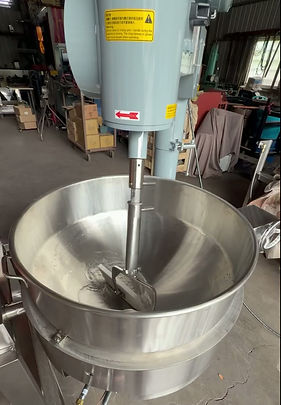
A cooking mixer is a food processing machine that combines heating, mixing, and stirring in a single process. Originally developed primarily for the production of bean paste and other traditional fillings, its continuous and even mixing action helps reduce localized scorching during heating and concentration, while producing a smooth and consistent texture.
As food processing applications have become increasingly diverse, cooking mixers are no longer limited to traditional bean paste production. With different bowl designs, mixing mechanisms, heating methods, and speed configurations, they can be used for a wide variety of products, including fillings, sauces, hot pot bases, meatball fillings, mochi, and other high-viscosity foods that require simultaneous heating and mixing.
Compared with manual stirring and cooking, a cooking mixer can significantly reduce labor requirements in large-batch production while improving consistency in heating, mixing, and final product texture. Different mixing systems and machine specifications can also be selected according to the viscosity, batch size, and processing requirements of each product, allowing the machine to serve applications ranging from traditional bakery fillings to sauces, prepared foods, and industrial food production.
Common Applications: Bean paste, red bean paste, mung bean paste, lotus seed paste, pineapple filling, various sauces, chili sauce, hot pot bases, meatball fillings, mochi, and other food products requiring heating, mixing, concentration, or continuous stirring.

Three Heating Options to Suit Different Processing Requirements
Depending on the type of food, production capacity, and available energy supply at the facility, MINIPAN cooking mixers can be configured with three different heating options: gas, steam, or thermal oil.
Each heating method offers different characteristics and can be selected to suit specific production processes, including bean paste, various fillings, sauces, hot pot bases, mochi, and other food products requiring heating and mixing.

Gas Type: LPG / Natural Gas
Gas heating uses LPG or natural gas as the heat source, providing rapid temperature rise and direct flame control. The system is relatively simple to install and is particularly suitable for production facilities without a steam boiler or centralized heating system.
The heat output can be adjusted according to different processing requirements, making it suitable for a wide range of fillings, sauces, and other food processing applications.

Steam Heating
Steam is introduced into the jacket surrounding the mixing bowl for indirect heating, providing more even and consistent heat distribution. This method is particularly suitable for food processing facilities that already have a steam boiler system.
Steam heating is a widely used industrial heating method for applications requiring stable temperature control and large-batch production.

Thermal Oil Heating
Thermal oil transfers heat through the jacket surrounding the mixing bowl, providing a higher and more stable operating temperature. It is particularly suitable for processes that require higher temperatures, extended cooking times, or concentration.
Because heat is transferred indirectly through the jacket, thermal oil heating also helps reduce localized overheating at the bottom of the bowl that can occur with direct flame heating.

Three Bowl Tilting Options to Suit Different Production and Operating Requirements
Depending on the production scale, bowl capacity, and operating requirements, MINIPAN cooking mixers are available with three bowl configurations: fixed bowl, manual handwheel tilting, or hydraulic tilting.
From the simple and reliable fixed-bowl design to hydraulic tilting for larger-scale production, the most suitable configuration can be selected according to specific processing and production requirements.

Fixed Bowl
The bowl features a fixed design with a simple and stable structure, making it suitable for products that do not require frequent tilting or can be discharged using other methods.
Its straightforward construction also makes the machine easy to operate and maintain.

Manual Handwheel Tilting
The bowl is tilted using a manual handwheel mechanism, allowing the operator to adjust the tilting angle as needed for easy discharge of the finished product.
This option is well suited for small to medium capacities and general batch production, offering a practical balance between equipment cost and ease of operation.

Hydraulic Tilting
The bowl is tilted by a hydraulic system, allowing the operator to control both tilting and return through the control system. This significantly reduces the physical effort required when discharging large batches from larger-capacity bowls.
It is particularly suitable for large-capacity production, high-viscosity products, and food processing applications requiring frequent batch production.